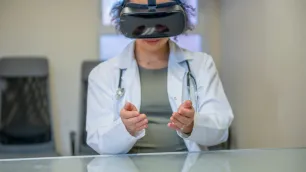




This informal CPD article ‘Building the Future Healthcare Learning Library’ was provided by Revolve Labs, who specialise in providing virtual reality medical education to make learning more accessible, engaging and effective.
A healthcare organisation invests in an excellent training module. It is used at a conference. A group of clinicians completes it. The feedback is positive. Then the event finishes. The equipment is packed away, the stand is dismantled and the learning experience becomes something that happened on one particular day. But what if it didn't have to end there?
What if every educational experience created for healthcare professionals could become part of a growing library that could be used again and again? That is where the real potential of immersive learning begins to emerge.
From individual experiences to an educational resource
VR and 360° learning are often introduced as individual projects: a module for a particular procedure, an experience for a congress or a training programme for a specific group. There is nothing wrong with this approach. But organisations can create significantly more value when they begin thinking beyond individual modules.
A clinical procedure captured in 360° can become part of staff induction. A VR simulation can support professional development months after it was created (1) (2). A medical device experience can be used by different teams and revisited when required. Over time, these experiences can form a digital learning library.
The value isn't simply in the number of modules. It is in having a collection of relevant, accessible learning experiences that can support professionals at different stages of their development.
Learning that is available when it is needed
Healthcare education doesn't always happen at a convenient time (3). A clinician may need to refresh their knowledge before undertaking a procedure. A new member of staff may need to understand an unfamiliar clinical environment (4). A healthcare professional may want to revisit a learning experience several weeks after completing it (5).
A library of immersive content gives learners that flexibility. Instead of waiting for the next course, conference or training session, they can return to relevant learning when they need it. This also creates opportunities for organisations to combine immersive content with other forms of CPD, including face-to-face teaching, discussion, reflection and supervised clinical practice. The technology becomes part of the wider educational programme rather than the programme itself.
Building something that improves over time
A good learning library should not remain static (6). New clinical requirements emerge. Procedures change. Technology develops. Learner feedback highlights opportunities for improvement. Immersive content can evolve alongside these changes.
Usage insights can show which experiences are being accessed (7). Learner feedback can identify areas that need refinement. Educators can decide where new content would provide the greatest value.
This creates a longer-term cycle:
Create → Deliver → Measure → Improve → Expand.
The result is not simply a collection of digital assets. It becomes an educational resource that grows with the organisation and its learners.
The opportunity for CPD
For CPD providers and healthcare organisations, the opportunity is becoming increasingly clear. The future isn't about replacing traditional education with VR. It is about giving healthcare professionals more ways to learn, practise, revisit and reflect (10) (11) (12).
A well-designed immersive learning library can help organisations preserve expertise, make specialist experiences more accessible (13) and extend the value of educational content long after its original creation. The most successful learning resources will not simply contain more content. They will contain better experiences, designed around what healthcare professionals actually need to learn and how they need to learn it.
And perhaps that is the most important shift of all. The question is no longer:
“Should we create a VR training module?”
It becomes:
“How can we build a learning resource that continues to deliver value to healthcare professionals long after the first learner puts on the headset?”
That is the opportunity for immersive CPD, and it is a developing field that is only just beginning.
We hope this article was helpful. For more information from Revolve Labs, please visit their CPD Member Directory page. Alternatively, you can go to the CPD Industry Hubs for more articles, courses and events relevant to your Continuing Professional Development requirements.
REFERENCES
(1) Kyaw BM, Saxena N, Posadzki P, Vseteckova J, Nikolaou CK, George PP, et al. Virtual Reality for Health Professions Education: Systematic Review and Meta-Analysis by the Digital Health Education Collaboration. Journal of Medical Internet Research. 2019;21(1):e12959. doi:10.2196/12959. https://doi.org/10.2196/12959
(2) Snyder CW, Vandromme MJ, Tyra SL, Hawn MT. Retention of colonoscopy skills after virtual reality simulator training by independent and proctored methods. The American Surgeon. 2010;76(7):743-746. PubMed ID: 20698383. https://pubmed.ncbi.nlm.nih.gov/20698383/
(3) Ikenwilo D, Skatun D. Perceived need and barriers to continuing professional development among doctors. Health Policy. 2014;117(2):195-202. doi:10.1016/j.healthpol.2014.04.006. https://doi.org/10.1016/j.healthpol.2014.04.006
(4) Monrouxe LV, et al. How prepared are UK medical graduates for practice? A rapid review of the literature 2009-2014. BMJ Open. 2017;7(1):e013656. doi:10.1136/bmjopen-2016-013656. https://pmc.ncbi.nlm.nih.gov/articles/PMC5253586
(5) Larsen DP, Butler AC, Roediger HL. Repeated testing improves long-term retention relative to repeated study: a randomised controlled trial. Medical Education. 2009;43(12):1174-1181. doi:10.1111/j.1365-2923.2009.03518.x. https://doi.org/10.1111/j.1365-2923.2009.03518.x
(6) Shojania KG, Sampson M, Ansari MT, Ji J, Doucette S, Moher D. How quickly do systematic reviews go out of date? A survival analysis. Annals of Internal Medicine. 2007;147(4):224-233. doi:10.7326/0003-4819-147-4-200708210-00179. https://pubmed.ncbi.nlm.nih.gov/17638714/
(7) Bojic I, Mammadova M, Ang CS, Teo WL, Diordieva C, Pienkowska A, et al. Empowering Health Care Education Through Learning Analytics: In-depth Scoping Review. Journal of Medical Internet Research. 2023;25:e41671. doi:10.2196/41671. https://doi.org/10.2196/41671
(8) Liu Q, Peng W, Zhang F, Hu R, Li Y, Yan W. The Effectiveness of Blended Learning in Health Professions: Systematic Review and Meta-Analysis. Journal of Medical Internet Research. 2016;18(1):e2. doi:10.2196/jmir.4807. https://doi.org/10.2196/jmir.4807
(9) Yoganathan S, Finch DA, Parkin E, Pollard J. 360° virtual reality video for the acquisition of knot tying skills: A randomised controlled trial. International Journal of Surgery. 2018;54:24-27. doi:10.1016/j.ijsu.2018.04.002. https://doi.org/10.1016/j.ijsu.2018.04.002
(10) Cervero RM, Gaines JK. The impact of CME on physician performance and patient health outcomes: an updated synthesis of systematic reviews. Journal of Continuing Education in the Health Professions. 2015;35(2):131-138. doi:10.1002/chp.21290. https://doi.org/10.1002/chp.21290
(11) Cook DA, Hatala R, Brydges R, Zendejas B, Szostek JH, Wang AT, et al. Technology-enhanced simulation for health professions education: a systematic review and meta-analysis. JAMA. 2011;306(9):978-988. doi:10.1001/jama.2011.1234. https://doi.org/10.1001/jama.2011.1234
(12) Sandars J. The use of reflection in medical education: AMEE Guide No. 44. Medical Teacher. 2009;31(8):685-695. doi:10.1080/01421590903050374. https://doi.org/10.1080/01421590903050374
(13) Barteit S, Lanfermann L, Bärnighausen T, Neuhann F, Beiersmann C. Augmented, Mixed, and Virtual Reality-Based Head-Mounted Devices for Medical Education: Systematic Review. JMIR Serious Games. 2021;9(3):e29080. doi:10.2196/29080. https://doi.org/10.2196/29080