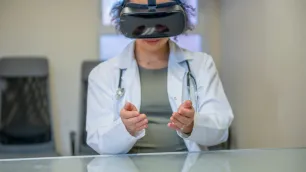




This informal CPD article ‘Learning Doesn’t End When the Headset Comes Off’ was provided by Revolve Labs, who specialise in providing virtual reality medical education to make learning more accessible, engaging and effective.
A healthcare professional completes a VR training module, removes the headset and returns to work. The training is complete. But is the learning?
For CPD providers and healthcare organisations, this is an increasingly important question. Completion rates and certificates can tell us whether someone accessed training, but they don’t necessarily tell us what they experienced, what they found useful or where they may need further support. (1) Immersive learning creates an opportunity to look beyond completion.
What happens during the learning experience?
One of the advantages of digital and immersive education is the ability to understand how learners interact with content. (2) Depending on the learning platform and module, it may be possible to see which sections were completed, where learners spent time, whether content was revisited and how users engaged with different parts of an experience.
This information can help educators ask better questions. (3), (4) If learners repeatedly return to one section of a clinical scenario, is it particularly valuable? Is the subject more complex? Would additional explanation improve the experience? The data doesn’t provide all the answers. But it can help identify where the questions should be asked.
Combining data with learner feedback
Engagement data becomes much more useful when combined with the learner’s own perspective. (5) A short feedback or confidence assessment can provide context around the experience. (1) Did the learner feel better prepared? Was the content relevant to their role? Was there anything they would change?
Together, these insights can give educators a clearer understanding of the learning experience. The goal isn’t to collect more data. The goal is to use the right information to improve learning.
From finished module to continuous improvement
This is particularly important when organisations begin building a library of immersive CPD content. A VR or 360° module shouldn’t necessarily be treated as finished the moment it is published. Learner feedback and engagement patterns can highlight opportunities to refine content, improve navigation or develop additional learning around a particular topic.
Over time, this creates a simple cycle:
Deliver → Measure → Learn → Improve. (6)
Each new group of learners can contribute to making the experience better for the next.
This approach can also help organisations make better decisions about future educational investment. Instead of simply asking how many people accessed a module, they can begin looking at how content is being used and where further development could have the greatest value.
Technology needs educational judgement
There is an important balance to maintain. Analytics should support educators, not replace them. Numbers alone cannot explain why a learner struggled with a particular section or whether an experience genuinely changed their confidence. Clinical expertise, learner feedback and professional judgement remain essential. (7) The strongest approach brings these elements together.
For CPD providers and healthcare organisations, the question is therefore moving beyond:
“Did they complete the training?”
towards:
“What did they experience, what did they take from it, and what can we improve?”
That shift is important.
Because effective CPD shouldn’t simply deliver learning. It should create a feedback loop that helps education become more relevant, engaging and useful over time. (6) And when the headset comes off, that is where the next stage of learning can begin.
We hope this article was helpful. For more information from Revolve Labs, please visit their CPD Member Directory page. Alternatively, you can go to the CPD Industry Hubs for more articles, courses and events relevant to your Continuing Professional Development requirements.
Next in the series: Building the Future Healthcare Learning Library – Turning Individual Learning Experiences into a Long-Term Educational Resource.
REFERENCES
(1) Kirkpatrick Partners. The Kirkpatrick Model. https://www.kirkpatrickpartners.com/the-kirkpatrick-model/ (accessed 29 October 2026)
(2) Sakr A, Abdullah T. Virtual, augmented reality and learning analytics impact on learners, and educators: a systematic review. Education and Information Technologies. 2024. doi:10.1007/s10639-024-12602-5. https://doi.org/10.1007/s10639-024-12602-5
(3) Chan T, Sebok-Syer S, Thoma B, Wise A, Sherbino J, Pusic M. Learning analytics in medical education assessment: the past, the present, and the future. AEM Education and Training. 2018;2(2):178–187. doi:10.1002/aet2.10087. https://pmc.ncbi.nlm.nih.gov/articles/PMC6001721/
(4) Thoma B, Ellaway RH, Chan TM. From utopia through dystopia: charting a course for learning analytics in competency-based medical education. Academic Medicine. 2021;96(7S):S89–S95. doi:10.1097/acm.0000000000004092. https://experts.mcmaster.ca/scholarly-works/1985710
(5) Henrie CR, Bodily R, Larsen R, Graham CR. Exploring the potential of LMS log data as a proxy measure of student engagement. Journal of Computing in Higher Education. 2018;30(2):344–362. doi:10.1007/s12528-017-9161-1. https://scholarsarchive.byu.edu/cgi/viewcontent.cgi?article=9050&context=facpub
(6) Clow D. The learning analytics cycle: closing the loop effectively. In: Proceedings of the 2nd International Conference on Learning Analytics and Knowledge (LAK12). ACM; 2012. doi:10.1145/2330601.2330636. https://doi.org/10.1145/2330601.2330636 (author’s version: https://oro.open.ac.uk/34330/1/LAK12-DougClow-personalcopy.pdf)
(7) Clow D. Data wranglers: human interpreters to help close the feedback loop. In: Proceedings of the 4th International Conference on Learning Analytics and Knowledge (LAK ’14). ACM; 2014:49–53. doi:10.1145/2567574.2567603. https://oro.open.ac.uk/40608