



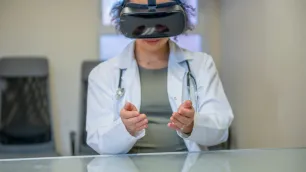
This informal CPD article ‘The Role of 360° Video in Healthcare CPD’ was provided by Revolve Labs, who specialise in providing virtual reality medical education to make learning more accessible, engaging and effective.
Healthcare professionals have always learned by observing others. (1) Whether it’s standing at the back of an operating theatre, shadowing an experienced clinician or watching a specialist procedure, observation plays an important role in developing clinical knowledge and confidence. (1) Often, some of the most valuable learning comes not from formal teaching but from seeing how experienced teams communicate, make decisions and respond to unexpected situations.
The challenge is that these opportunities aren’t always available. Clinical placements are limited, operating theatres can only accommodate a small number of observers and busy healthcare environments don’t always allow time for everyone to experience specialist procedures first-hand. (2) This is where 360° video is creating new opportunities for Continuing Professional Development. (3)
Bringing clinical environments closer
Unlike a traditional training video, 360° content places the learner inside the clinical environment. Rather than watching from a fixed camera angle, they can look around the room, observe interactions between team members and explore the wider setting as if they were there. (4)
This creates a more realistic learning experience and provides valuable context that standard video often cannot capture. Learners are able to observe not only the procedure itself, but also the preparation, communication and teamwork that are essential to delivering safe, effective patient care. (4), (5)
Making specialist learning more accessible
Many healthcare professionals may never have the opportunity to observe certain procedures in person. Distance, clinical commitments and limited capacity can all make access difficult. (6), (7) With 360° learning, those experiences become available whenever they are needed. (6)
A clinician preparing for a new procedure can revisit the operating theatre before assisting for the first time. (4) A community nurse can explore unfamiliar care environments before visiting patients. Medical device specialists can better understand how their technologies are used within real clinical settings. The aim isn’t to replace practical experience but to help professionals arrive better prepared and more confident. (4), (8), (9)
Supporting flexible CPD
One of the greatest strengths of 360° learning is its flexibility. (10) Healthcare professionals can access learning at a time that suits them, revisit key moments as often as required and learn at their own pace. This is particularly valuable for busy clinical teams balancing education alongside patient care.
For organisations, it also creates consistent learning experiences across multiple hospitals, departments and geographical locations, helping ensure that every learner has access to the same high-quality educational content.
Building a lasting educational resource
Every filmed procedure, clinical environment or expert demonstration has the potential to become more than a one-off training session. As organisations continue to invest in education, many are creating libraries of 360° learning experiences that can be used repeatedly for staff induction, CPD, product education and clinical training. Over time, these libraries become valuable educational assets, allowing new healthcare professionals to benefit from the experience and expertise of others whenever they need it.
Clinicians, NHS organisations and healthcare partners increasingly use immersive 360° learning experiences that can support practical education across a wide range of clinical settings. By capturing real healthcare environments and making them available on demand, organisations can extend the reach of expert teaching while giving healthcare professionals greater flexibility in how they learn.
Healthcare education has always been built on observation, experience and reflection. Today, 360° technology is helping make those experiences more accessible, ensuring that more professionals can learn from real clinical practice, wherever they are.
We hope this article was helpful. For more information from Revolve Labs, please visit their CPD Member Directory page. Alternatively, you can go to the CPD Industry Hubs for more articles, courses and events relevant to your Continuing Professional Development requirements.
Next in the series: Learning Doesn’t End After the Headset Comes Off – Using Insight and Analytics to Strengthen Healthcare Education.
REFERENCES
(1) Cordovani L, Cordovani D. A literature review on observational learning for medical motor skills and anesthesia teaching. Advances in Health Sciences Education. 2016;21(5):1113–1121. DOI: 10.1007/s10459-015-9646-5. https://link.springer.com/article/10.1007/s10459-015-9646-5
(2) Tanaka T, Suehiro E, Inagawa S, Matsuno A. Seeing Is Believing: Real-Life 360-Degree Virtual Reality as a Catalyst for Neurosurgical Interest. Cureus. 2025 (21 April). DOI: 10.7759/cureus.82720. https://www.ncbi.nlm.nih.gov/pmc/articles/PMC12094806/
(3) Blair C, Walsh C, Best P. Immersive 360° videos in health and social care education: a scoping review. BMC Medical Education. 2021;21:590. DOI: 10.1186/s12909-021-03013-y. https://pmc.ncbi.nlm.nih.gov/articles/PMC8611631
(4) Arents V, de Groot PCM, Struben VMD, van Stralen KJ. Use of 360° virtual reality video in medical obstetrical education: a quasi-experimental design. BMC Medical Education. 2021. DOI: 10.1186/s12909-021-02628-5. https://link.springer.com/doi/10.1186/S12909-021-02628-5
(5) Manser T. Teamwork and patient safety in dynamic domains of healthcare: a review of the literature. Acta Anaesthesiologica Scandinavica. 2009;53(2):143–151. DOI: 10.1111/j.1399-6576.2008.01717.x. https://www.researchgate.net/publication/23496448_Teamwork_and_patient_safety_in_dynamic_domains_of_healthcare_a_review_of_the_literature
(6) Live VR operating room learning experiences. NZ Optics (staff reporters). 12 March 2019. https://nzoptics.co.nz/live-articles/live-vr-operating-room-learning-experiences/
(7) Mills L, Davis H, SPARCs Collaborative, Okocha M, et al. Barriers to operative exposure in foundation training. The Surgeon. 2026. DOI: 10.1016/j.surge.2026.04.010. https://www.sciencedirect.com/science/article/pii/S1479666X26000351
(8) Baysan A, Çonoğlu G, Özkütük N, Orgun F. Come and see through my eyes: A systematic review of 360-degree video technology in nursing education. Nurse Education Today. 2023;128. DOI: 10.1016/j.nedt.2023.105886. https://avesis.mcbu.edu.tr/yayin/3d557174-dd55-4ca6-9834-a801e5b0a3ff/come-and-see-through-my-eyes-a-systematic-review-of-360-degree-video-technology-in-nursing-education
(9) Chao Y-P, Kang C-J, Chuang H-H, et al. Comparison of the effect of 360° versus two-dimensional virtual reality video on history taking and physical examination skills learning among undergraduate medical students: a randomized controlled trial. Virtual Reality. 2023;27:637–650. DOI: 10.1007/s10055-022-00664-0. https://link.springer.com/article/10.1007/s10055-022-00664-0
(10) Brien L-A, Ha L, Larue C, Crétaz M, Lavoie P. Interactive 360-degree videos for online nursing professional development. Accepted manuscript. 2025. Université de Montréal institutional repository. https://hdl.handle.net/1866/41436