


This informal CPD article ‘Mesothelioma Awareness Day: Why Past Exposure Still Shapes Today's Duties’ was provided by AAA Training Co, a Global Health & Safety Management training organisation with a depth of knowledge of occupational health, safety and risk management, drawing on a fund of experience that's been gained over many years.
Mesothelioma Awareness Day, 26 September
Mesothelioma Awareness Day falls on 26 September. It is an opportunity to remember those who have died from the disease, to recognise the patients and families currently living with it, and to reflect on what the history of asbestos in Britain means for people who work in, maintain or manage older buildings today. In the UK, the day sits alongside Action Mesothelioma Day, held on the first Friday in July (1), and both serve a similar purpose: keeping a largely preventable disease in public view.
What is mesothelioma?
Mesothelioma is a cancer of the mesothelium, the thin lining that covers the lungs (pleura) and, less commonly, the abdomen (peritoneum). It is caused almost exclusively by past exposure to asbestos (2)(3). When asbestos-containing materials are damaged or disturbed, microscopic fibres can be released and inhaled. Some of these fibres lodge in the body and, over many years, can lead to disease.
One of the defining features of mesothelioma is its long latency. The Health and Safety Executive (HSE) notes that the time between first exposure and the disease appearing is typically at least 30 years (3). This means that the deaths recorded today largely reflect exposures that happened decades ago, and that any exposure occurring now may not show its consequences until the 2050s or later. Treatment options have developed, but when the disease is found at an advanced stage it can be very hard to treat and it may not be possible to cure it (4).
The current picture in Great Britain
HSE statistics published in July 2026 show that 2,146 people died from mesothelioma in Great Britain in 2024: 1,771 men and 375 women (3). This is 109 fewer than in 2023 and substantially lower than the average of 2,508 deaths per year over the period 2011 to 2020 (3)(5). More than 70% of deaths now occur in people aged over 75, which is consistent with exposure having taken place mainly before the 1980s (3).
Mesothelioma is only part of the picture. HSE estimates that asbestos causes around 5,000 deaths every year in total, once asbestos-related lung cancer and asbestosis are included (6).
The downward trend is encouraging and is consistent with the impact of decades of tighter controls, culminating in the prohibition of the import, supply and use of all types of asbestos in the UK in 1999 (7). However, the statistics also carry a note of caution. HSE expects deaths among men to reduce through the 2020s, but for women a clear decline may not be evident until towards the end of the decade (3). Historic exposure was also concentrated in particular occupations: one study cited by HSE attributed around 46% of mesotheliomas among men born in the 1940s to work in the construction industry, with 17% attributed to carpentry alone (3).

The Health and Safety Executive (HSE)
Why the risk has not gone away
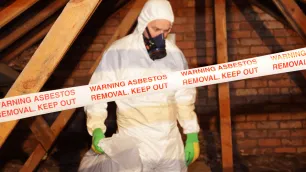
Although asbestos has been prohibited from use in the UK since 1999 (7), a great deal of it remains in place. HSE advises that asbestos can be found in any building built before the year 2000 (6). Where these materials are in good condition and left undisturbed, the risk is generally low. The problem arises when they are drilled, cut, broken, sanded or removed without the right information and controls (10).
That is why the people most at risk today are often those carrying out routine maintenance, refurbishment and installation work: electricians, plumbers, joiners, heating engineers, decorators and general maintenance staff (8). Their work regularly takes them into ceiling voids, risers, plant rooms and service ducts, where asbestos-containing materials are commonly found. The decisions made by those who manage buildings, commission work and supervise contractors have a direct bearing on whether that exposure happens.
Three practical messages
Don't take the risk: If a material could contain asbestos and there is no reliable information to say otherwise, it should be treated as though it does. Regulation 4 of the Control of Asbestos Regulations 2012 (CAR 2012) requires duty holders of non-domestic premises to presume materials contain asbestos unless there is strong evidence that they do not (9)(10). Before refurbishment or demolition work, a refurbishment and demolition survey, as described in HSE guidance HSG264, is normally needed for the areas affected (11).
Don't do things you'll regret in years to come: Because of the long latency, the consequences of a single careless job may not be felt for decades, by which time nothing can be done to reverse them. Practical steps include:
- checking the asbestos register and survey information before any work that could disturb the building fabric (10);
- making sure workers have received information, instruction and training appropriate to their role, as required by Regulation 10 of CAR 2012 (9);
- stopping work immediately if suspected asbestos is uncovered unexpectedly and seeking advice before continuing (10).
Don't assume it's someone else's job: The duty to manage asbestos applies to whoever has responsibility for the maintenance or repair of non-domestic premises, whether through a contract, a tenancy or control of the building (9). That duty includes identifying the location and condition of asbestos, assessing the risk, preparing and implementing a plan to manage it, and passing information to anyone who may disturb it (9)(10). In practice, responsibilities are often shared between owners, managing agents, facilities teams and contractors. Clear communication between them is essential, because gaps in that chain are where exposure tends to occur.
Supporting HSE's campaigns
HSE runs two complementary asbestos campaigns as part of its Work Right programme (8). "Asbestos - Your Duty" is aimed at people responsible for the maintenance and repair of buildings, reminding them of their legal duty to manage asbestos. "Asbestos & You" is aimed at skilled trades, helping workers to know what to look for and what to do to protect themselves (8). Both are free to use, and organisations can help by sharing the campaign materials with staff, contractors and supply chains, particularly around Mesothelioma Awareness Day.
Conclusion
The falling number of mesothelioma deaths shows that regulation and good practice make a difference. At the same time, the long latency of the disease means that today's figures cannot tell us how well asbestos is being managed now. That will only become clear in the decades ahead. Mesothelioma Awareness Day is a reminder that the people who will benefit most from careful asbestos management are today's workers, and that everyone involved in older buildings has a part to play.
We hope this article was helpful. For more information from AAA Training Co, please visit their CPD Member Directory page. Alternatively, you can go to the CPD Industry Hubs for more articles, courses and events relevant to your Continuing Professional Development requirements.
REFERENCES
(1) Asbestos Victims Support Groups Forum UK. Action Mesothelioma Day. https://asbestosforum.org.uk/amd/
(2) NHS. Mesothelioma. https://www.nhs.uk/conditions/mesothelioma/
(3) Health and Safety Executive (2026). Mesothelioma statistics for Great Britain, 2026. https://www.hse.gov.uk/statistics/assets/docs/mesothelioma.pdf
(4) NHS. Treatment for mesothelioma. https://www.nhs.uk/conditions/mesothelioma/treatment-for-mesothelioma/
(5) Health and Safety Executive (2026). Latest annual work-related fatalities published. Press release, 1 July 2026. https://press.hse.gov.uk/2026/07/01/latest-annual-work-related-fatalities-published-2/
(6) Health and Safety Executive. Asbestos. https://www.hse.gov.uk/asbestos/
(7) The Asbestos (Prohibitions) (Amendment) Regulations 1999 (SI 1999/2373). https://www.legislation.gov.uk/uksi/1999/2373/contents/made
(8) Health and Safety Executive. Work Right campaigns: Asbestos - Your Duty and Asbestos & You. https://workright.campaign.gov.uk/
(9) The Control of Asbestos Regulations 2012 (SI 2012/632). https://www.legislation.gov.uk/uksi/2012/632
(10) Health and Safety Executive (2013). L143 Managing and working with asbestos: Control of Asbestos Regulations 2012, Approved Code of Practice and guidance (2nd edition). https://www.hse.gov.uk/pubns/books/l143.htm
(11) Health and Safety Executive (2012). HSG264 Asbestos: The survey guide (2nd edition). https://www.hse.gov.uk/pubns/books/hsg264.htm