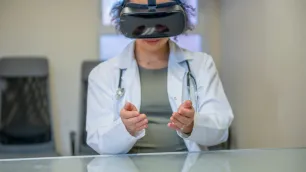



This informal CPD article ‘Healthcare Education is Changing. Is Your CPD Keeping Up?’ was provided by Revolve Labs, who specialise in providing virtual reality medical education to make learning more accessible, engaging and effective.
“I completed the training, but I still didn’t feel ready.” It’s a comment heard across healthcare every day. A nurse completes mandatory e-learning before using a new device. A junior doctor watches a recorded procedure before assisting in theatre. A healthcare professional attends a conference, takes pages of notes and returns to work inspired, only to realise that much of what they learned begins to fade within days (1). The knowledge was delivered. The training was completed. Yet confidence doesn’t always follow.
For many healthcare professionals, the challenge isn’t accessing education. It’s translating knowledge into confident practice. As clinical practice continues to evolve, Continuing Professional Development (CPD) must evolve with it.
Beyond information, towards experience
Traditional learning methods remain an essential part of healthcare education. Lectures, e-learning, workshops and conferences all play an important role in developing knowledge and maintaining professional standards.
However, healthcare is a practical profession. Reading about a procedure or watching someone else perform it is not the same as experiencing the clinical environment, observing how a multidisciplinary team works together or understanding the small decisions that influence patient care.
This is why immersive learning is attracting increasing interest across healthcare (2), (3). Virtual Reality (VR) and 360° video give healthcare professionals the opportunity to step inside real clinical environments, observe procedures from the clinician’s perspective and revisit complex scenarios whenever they need to (4). Rather than replacing traditional education, immersive learning complements it by providing greater context, realism and engagement (4), (5), (6), (7).
Building confidence before clinical practice
Confidence develops through experience. While no digital technology can replace supervised clinical practice, immersive learning helps professionals become more familiar with procedures, environments and workflows before they encounter them in real life.
For newly qualified staff, it can reduce uncertainty before entering an unfamiliar clinical setting (8). For experienced clinicians, it offers an opportunity to refresh knowledge before adopting new equipment, techniques or treatment pathways. It also provides consistent access to specialist learning experiences that may otherwise be difficult to arrange (9). Learning becomes something participants actively experience rather than simply observe (10).
Making CPD more accessible
Healthcare organisations face increasing pressure to deliver high-quality education while balancing clinical demands, workforce shortages (11) and limited time for training. Immersive learning supports these challenges by making education more flexible and accessible (2).
Healthcare professionals can revisit learning when it suits them, organisations can deliver consistent training across multiple locations, and educators can create engaging learning experiences without relying solely on face-to-face sessions (2), (12). As part of a blended learning approach, VR and 360° education can help make CPD more engaging while supporting learners with different levels of experience (4).
A growing role in healthcare education
Across the NHS, universities, pharmaceutical companies and MedTech organisations, immersive learning is becoming an increasingly valuable addition to existing education programmes (2), (12). Healthcare education will always rely on skilled educators, practical experience and reflective practice. Technology doesn’t replace these foundations. It strengthens them.
As expectations around CPD continue to grow, organisations have an opportunity to combine traditional teaching with immersive learning to create education that is more engaging, more accessible and, most importantly, more relevant to everyday clinical practice.
We hope this article was helpful. For more information from Revolve Labs, please visit their CPD Member Directory page. Alternatively, you can go to the CPD Industry Hubs for more articles, courses and events relevant to your Continuing Professional Development requirements.
Next in the series: Why We Remember Experiences Better Than Slides – Exploring the Science Behind Immersive Learning.
REFERENCES
(1) Murre JMJ, Dros J. Replication and Analysis of Ebbinghaus’ Forgetting Curve. PLoS ONE. 2015;10(7):e0120644. https://doi.org/10.1371/journal.pone.0120644
(2) NHS England (formerly Health Education England). Technology Enhanced Learning (TEL). https://www.hee.nhs.uk/our-work/technology-enhanced-learning
(3) Baysan et al. Come and see through my eyes: A systematic review of 360-degree video technology in nursing education. Nurse Education Today. 2023. https://www.sciencedirect.com/science/article/abs/pii/S0260691723001806
(4) Immersive 360° videos in health and social care education: a scoping review. BMC Medical Education. 2021. https://link.springer.com/article/10.1186/s12909-021-03013-y
(5) Kyaw BM, Saxena N, Posadzki P, Vseteckova J, Nikolaou CK, George PP, Divakar U, Masiello I, Kononowicz AA, Zary N, Tudor Car L. Virtual Reality for Health Professions Education: Systematic Review and Meta-Analysis by the Digital Health Education Collaboration. Journal of Medical Internet Research. 2019;21(1):e12959. https://www.jmir.org/2019/1/e12959/
(6) Lindner M, Leutritz T, Backhaus J, König S, Mühling T. Knowledge Gain and the Impact of Stress in a Fully Immersive Virtual Reality–Based Medical Emergencies Training With Automated Feedback: Randomized Controlled Trial. Journal of Medical Internet Research. 2025;27:e67412. https://www.jmir.org/2025/1/e67412
(7) Tannemann N, Tsarenko O, Herbstreit F, Gestmann M, Brenner T, Szalai C. Enhancing theoretical BLS knowledge with virtual reality: a randomized controlled trial in medical students. PubMed PMID 41437944. https://pubmed.ncbi.nlm.nih.gov/41437944/
(8) New Nurse Self-assessed Clinical Competence, Immersion, and Attitudes Following Virtual Reality Training on the Assessment of Pediatric Respiratory Distress. https://www.sciencedirect.com/science/article/abs/pii/S1876139923000750
(9) Sousa VTS, Martins LVC, Vasconcelos PF. Exploring horizons: expanding nursing education with immersive 360º videos. 2025. https://www.ncbi.nlm.nih.gov/pmc/articles/PMC11731845/
(10) Tian et al. Immersive virtual reality versus traditional instruction for long-term retention of cardiopulmonary resuscitation skills in medical student education: A randomized controlled trial. Hong Kong Journal of Emergency Medicine. 2026. https://onlinelibrary.wiley.com/doi/10.1002/hkj2.70099
(11) NHS England. NHS Long Term Workforce Plan. https://www.england.nhs.uk/long-read/nhs-long-term-workforce-plan-2/
(12) NHS England East of England. Immersive VR training for NHS staff developed in the east of England. 22 May 2024. https://www.england.nhs.uk/east-of-england/2024/05/22/immersive-vr-training-for-nhs-staff-developed-in-the-east-of-england/